

All of my posts may contain affiliate links. This means if you use the links in my articles to book, I may make a small profit, at zero cost to you, which helps me keep writing these posts! I only endorse products and companies I actually like and have used.
Of all the countries I have been to, the one about which I get the most questions is, without doubt, Madagascar. Within Madagascar, I get the most questions about Tsingy de Bemaraha National Park. As un-traversable as it is wild, Madagascar is truly other-worldly and a beautiful undiscovered mystery for most travellers, no matter how intrepid.
Really though, once you are there, Madagascar is relatively easy to explore, thanks to the friendly and helpful locals, and array of tour guides keen to offer their services. Unquestionably, the most unique place we visited in Madagascar was Tsingy de Bemaraha National Park, and it was the place around which we centred most of our trip.
This post is intended as a full guide; how to get there and what exactly you can expect.
Planning your trip:
🩺 Don’t forget to protect your trip with travel insurance. We use and love SafetyWing!
🗣 Check for the best tours and activities on GetYourGuide and Viator
🛏 Find the cheapest rates for your stays on Booking.com!
Table of Contents
- What is Madagascar’s Tsingy de Bemaraha National Park?
- Getting to the Tsingys
- When to go
- Where to Stay
- Costs:
- Packing List for Tsingy de Bemaraha National Park
- Top Tips

What is Madagascar’s Tsingy de Bemaraha National Park?
Tsingy de Bemaraha (fondly known by locals as ‘The Tsingys’ is a National Park in Madagacascar, comprised largely of sheer limestone cliffs. In Malagasy, we were told Tsingy means ‘tiptoe’ and the locals call it this because in order to get around in on bare feet, they used to tiptoe around on the craggy spikes. We later learned that it loosely means ‘where one cannot walk barefoot’.
Most people choose to visit because of the dramatic scenery and fun hiking trails, but it also contains a vast diversity of wildlife (like many places in Madagascar). Of course, the most iconic form of wildlife to see is lemurs in Madagascar, but you can also see many weird and wonderful insects, and some beautiful tropical birds. That’s not even to mention the stunning plants and trees that can be found here – much of which is completely endemic to Madagascar and cannot be found anywhere else.

✨Interested in Madagascan lemurs? Save our guide to ethical lemur spotting to read later!
It’s an unusual safari experience, since there is no way to tackle it by vehicle, so sadly it is only open to those able to climb and hike their way through the dense canopy and challenging bouldering routes. There are two sides to the National Park, Grand Tsingy and Petit Tsingy, visually similar but each presenting a different hiking/climbing experience.

Grand Tsingy
Grand Tsingy quick information:
🌉 This is where you can experience the famous rope bridge!
🧗♀️ You need to use a harness and ropes to climb Grand Tsingy
☀ Set off as early as you can, as the sun is intense!
✋ Take a local guide so you don’t get lost – if you’re travelling independently, we love this tour with Viator, which includes both Tsingys and the boat ride there*!
⏲ This should be about 4-6 hours depending on the route you take
🛌 The best place to stay to access both Tsingys is Bekopaka
**NOTE: this is not easy to self-organise
As the name suggests, Grand Tsingy is the bigger of the two Tsingys, i.e. the two parts of the National Park. It’s home to the iconic rope bridge, which most travellers want to visit when they travel to the Tsingys. You can hike Grand Tsingy in a day (trails range between 4-6 hours and varying difficulty) or you can choose to hike overnight and camp.
Purely on the recommendation of our guide, we took the day trail (Ranotsara Trail) of four hours, and this was probably a smart idea, given the heat (and the fact that we had just arrived from UK autumn weather). The trail was circular and we actually managed it in a slightly shorter time frame. We had a feeling the estimates given were quite generous and intended for those without much climbing experience.
While we were hiking, we came across lemurs purely by chance! We just looked up and there was a whole group of white sifaka staring at us. We also saw some cool birds and plants and even a weevil, which our guide was very excited about, as apparently they are very rare.

It’s recommended to take a guide with you for the climb, if for no other reason than the fact that the trails are not marked (except where there are ropes) and you could easily get lost. You need a rope harness for Grand Tsingy, and it’s ideal to have some degree of upper body strength, as there are sections where you need to pull yourself up on rocks to get to the next point.
The guides are very happy to give you a quick crash course on how to use the rope clips and attempt the trail, and did not seem bothered by low levels of experience. This is likely because, as rope climbs go, it is not difficult, and you are more likely to be floored by the intense sun and heavy humidity of the rainforest.
There was actually an 83 year old taking on the climb in the group after us (she was fantastic!) and she managed it, though admittedly in a much longer time frame. We would point out though that she was a particularly determined and resilient 83 year old! It was still a tough climb for most of us.

We set off around 8am, and the sun wasn’t too bad; you are using ropes for most of the climb, though I think we had around 30-40 minutes without at the start of the trail. Then follows a steady ascent through the rocks – it isn’t too difficult as long as you take your time and follow instructions to ensure you are always clipped on to the barriers. There were sections where we needed to pull ourselves upwards through the rocks, or clamber across large stepping stone-style boulders. The guides have created a trail which is easy to follow, and there are no points where real expertise is required.
There are several viewing platforms along the way where you can stop and soak it all in, our favourite was the platform over the Manambolo Gorge. The guides are wonderful and will take your picture/videos for you at any point. They are also very good at setting a pace and ensuring you are OK and coping with the climbing. The rope bridge is the second ‘summit’ that you reach, so you have to go down hill a little before you climb back up to it.
The final stop, which should be around lunchtime (though for some reason we arrived at 10am!) is ‘the Cathedral’. This is shown in the picture below. It’s super cool and shady, which makes it a great spot for lunch, as the rest of the hike is very hot and sweaty. After the cathedral, it’s an easy descent to the bottom.

Petit Tsingy
Petit Tsingy quick information
🛶 Can only be accessed by wooden canoe (a pirogue)
☀ Set off as early as you can, as the sun is intense!
✋ Take a local guide so you don’t get lost – if you’re travelling independently, I love this tour with Viator, which includes both Tsingys and the boat ride there*!
⏲ This should be about 4-6 hours depending on the route you take
🛌 The best place to stay to access both Tsingys is Bekopaka
**NOTE: this is not easy to self-organise
Petit Tsingy was a different experience in itself for us, because we had to take a pirogue (dug out canoe) to the start point through Manambolo Gorge. This was a very serene and lovely experience floating along the water, and we were also able to explore some caves and see the famous tomb of the Vazimba tribe, who are buried in one of the cliff caves on the water’s edge.
That being said, having already had an hour or so’s exposure to the sun in the morning, we were already feeling quite hot by the time we started our ascent of Petit Tsingy, and we felt we probably should have set off even earlier (we started at 8am). For us, this was by far the more challenging of the two days, despite being much smaller than Grand Tsingy, as we had opted for a 6 hour route on the Andadoany Trail (having found the day before quite easy!) and had the time in the sun at the start.

Our guide told us the 6 hour route was more interesting, but we later learned it was just an extension of the four hour trail, with some going back on ourselves and then walking back along the river (in full sun!) which we had already seen in the canoe. We suspect he may have just fancied a longer walk! By the end of the day, we were definitely suffering from heat exhaustion. It was really a lesson for us not to underestimate Madagascan weather, and we probably should have stuck to the four hour route for more enjoyment.
That being said, it did provide a different perspective on the gorge – though it was just a lot of time in blazing sunshine on the top of the cliffs.

Which Tsingy should you choose?
We would definitely recommend checking out both Tsingys if you have time, as they are both so different, but if you can only do one and you have good physical fitness, we’d suggest Grand Tsingy over Petit.
This is mainly because of the rope bridge, but we did also find the scenery of Grand Tsingy more interesting. This could have been because we were more impressed on the first day. That being said, if you miss out Petit Tsingy, you’ll miss the boat trip.
Really each one is unique in their own way and well worth visiting.

Getting to the Tsingys
The Tsingys are technically very difficult to access (though don’t let that put you off!), but there are two main ways it can be done.
Overland
You need to head first to Morondava, a pretty beach town on the West Coast of Madagascar, which can be reached by car from Antananarivo, or by flight. We couldn’t see any scheduled airlines offering the route from Tana (but this wouldn’t have been our choice of travel anyway).
It’s roughly 15 hours driving though, so it’s highly recommended to break up the journey somewhere, such as Ambositra. In additional to this, the drive from Morondava to Tsingy NP is about 8 hours and quite challenging terrain, so it is a lot of time to be in a car.
As you can see, the route doesn’t look very logical, which is why in our opinion it is better to take a boat.
Via boat
This was what we chose to do, and I would highly recommend it, though it is the longer of the two routes so it isn’t ideal if time is of the essence. The entrance to the Tsingys can be accessed from the Tsiribihina River, on which you can take a boat cruise. We used Espace Mada , who were absolutely incredible, and even helped us find a driver for the rest of our trip, and offered us a way to save money by combining our trip with another group. I wrote a full guide to this experience here.
Read the full guide to getting to the Tsingys via boat here!
The trip took 2 nights and 3 days, and offered us the opportunity to see more wildlife and experience the tranquillity and sights of the Tsiribihina River, which was a total local gem we would never have found otherwise. The only thing I’d caution is that this was a trip with wild camping, so think twice if this isn’t your style!
You start the trip at Miandrivazo and finish at Bekopaka, which is the entry point to the Tsingys. Both places are tagged on the map above.
If you’d rather have everything organised for you, you can take this tour with Viator, which includes hiking both Tsingys (not included in many other tours) and the boat ride to the Tsingys, which is not easy to organise on your own!
Check availability here.

When to go
The park is open from April to November (June-November for Grand Tsingy), which means only outside of Madagascar’s rainy season, because it is otherwise too dangerous.
We visited in October (we actually changed round our entire trip to ensure we could visit this park!) and apart from the heat and humidity, it was fine! It didn’t rain at all while we were there, just sunny all the way.
The opening times do vary, and some years the park guides will keep the park open longer if there is no rain, but tours do not tend to run during this time, just in case they are rained off.
✨ I recommend booking a trip between June – November is visiting Tsingy de Bemaraha National Park!
Where to Stay
There are three hotels just outside of Tsingy de Bemaraha, all in Bekopaka town.
We stayed in the budget option, Orchidée de Bemaraha, which we were able to book by emailing them (orchideedubemaraha@gmail.com – in French – though I am sure they would respond in English as there were English-speaking staff on site). It was fine for a budget hotel, though quite honestly a little more than we would have expected to pay given the range of facilities – they charge more owing to their remote location. They do have a pool and restaurant, and the rooms are comfortable enough.
The hotels in Bekopaka are all quite keen to have you eat with them every night, and most of them do have nice menus, but bear in mind, there are also nice local options in Bekopaka town. It’s important to spread out the money from tourism in the area if possible, so that everyone benefits.
There are two slightly more upmarket hotels – Olympe de Bemaraha (which is a mid-range hotel) with nice views, and Le Soleil des Tsingy (marketed as luxury – I would just be aware that it’s not real, real luxury, as this is not common in Western Madagascar, but it is certainly the most upmarket hotel in Bekopaka).
✨ The hotel I recommend is Olympe de Bemaraha, since it’s affordable, well-located with nice views and easily booked online!
Check availability for your dates here or, alternatively, check what’s available via the map below

Bekopaka Town
We did explore Bekopaka, just to see what was going on.
There is not much here really – we went for a very casual dinner on the second night we stayed here. It is a short (5 minute) drive or 15 minute walk from Orchidée de Bemaraha. For some reason our driver would not let us walk, though I do think he was just being a little overprotective as it all seemed fine.
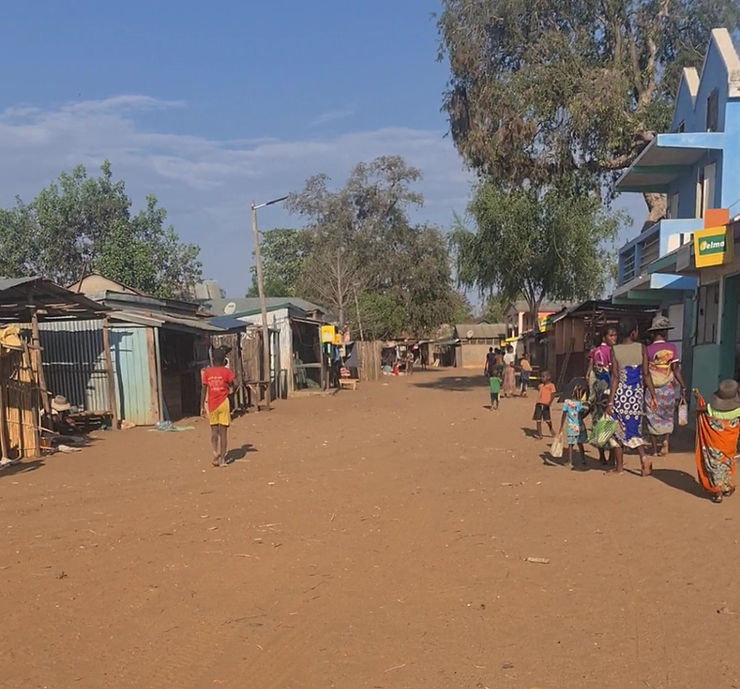
The town is one high street, with a few local market stalls and maybe 3 or 4 restaurants (/kitchens), all selling local food. It’s worth wandering into, if you like to see local life and not just the touristy spots, but there is nothing out of the ordinary worth venturing out for.
Costs:
✨Park entrance fee MGA 55,000 each (around $10 USD)
✨ Compulsory guide fee MGA 135,000 for the group (around $30 USD)
✨ Community park fee MGA 10,000 each (around 2 USD)
✨ Fee for the vehicle to enter park MGA 5,000 each (around 1 USD)
✍ Total cost: 260,000 MGA (roughly £45 / $50) for the two days depending on exchange rate
Note: even if you already have a guide in Madagascar or a driver, you need to book an additional guide for Tsingy de Bemaraha National Park. If you have a driver/guide already, they can help you organise this. Otherwise, you can arrange it easily in person at the entrance to the park.
On most pre-booked tours, such as the one I recommended earlier with Viator, the guide is included for you.
Packing List for Tsingy de Bemaraha National Park
☀ A sunhat and copious amounts of suncream are essential.
Please be sure to always only use reefsafe suncream in Madagascar as it’s an endangered area and typical suncream can harm the ecosystem – we use Incognito’s sunscreen, which is totally reef-safe and nano-free. ‘Reefsafe’ is not a protected term, so some suncreams may claim to be reef-safe and not be at all. I recommend cross-checking the chemicals in your cream with those listed on Save The Reef.
🦟 Bug spray/insect repellent.
Again, it’s really important only to use natural repellent so as to avoid damaging the local ecosystem. We also use Incognito for this and honestly we love it, it’s better than any deet-based spray we’ve ever used. We vetted a lot of suncreams and insect repellents before committing, and we really are happy with them.
Get 20% off Incognito suncream or insect repellent here!
👀 Binoculars and a great camera would come in very useful, as there are some great opportunities for wildlife spotting!
🥪 A packed lunch is good for your break – you can ask your hotel to prepare one for you. I highly recommend to take at least 2 litres or more of water, as it is exceptionally hot, and you can easily dehydrate.
👖 Comfortable hiking clothes and boots.
For Grand Tsingy, I recommend long trousers or leggings, as the rope harnesses can be uncomfortable otherwise.
NOTE: It is unlikely to rain in Tsingy de Bemaraha National Park, as it is closed during the rainy season, and it is almost always very sunny, however checking the weather each day always pays off!

Top Tips
⌚ Start hiking as early as you can – the park is apparently open 24 hours, but check with your guide when is the earliest time you can get in.
🎟 Get your tickets in advance if you can to allow more time to hike. Our driver offered to go and get our tickets in advance the day before so we would not have to do this on arrival and it was a smart idea and saved us a lot of time in the morning.
🧗♀️ I would recommend to have some bouldering experience before attempting this climb and you need to be fit enough to pull yourself up on the rocks. Unfortunately the park is not very accessible for those with disabilities, as is sadly the case with most of Madagascar. Increased tourism will help their infrastructure and hopefully allow them to put these measurements in place.
You might also find useful:
✨Andasibe Mantadia National Park visiting guide
✨ Wild camping on the Tsiribihina River
✨ Should you visit Lemur Island in Madagascar?
✨ Car hire in Madagascar (with and without a driver) – what you need to know!
✨ When is the best time to visit Madagascar for wildlife?
✨ The perfect 3 week Madagascar itinerary
✨ Here’s why you shouldn’t feed lemurs!
✨ Can you travel to Madagascar responsibly?
✨ Visiting the traditional aluminium workshops in Ambatolampy, Madagascar
If you want to refer back to this page, bookmark it! If you have a comment, question or a way we could improve it, please let us know below – your email address won’t show!
Or alternatively, if you love sustainable travel…
🤍 Follow us on Instagram and TikTok, where I post sustainable travel tips and information
📰 Sign up to the newsletter, to get my free sustainable travel checklist!
📽 Subscribe on YouTube, where you can watch all episodes of The Sustainable Travel Podcast, also on Spotify!
👍 Join the Facebook Community or the Sustainable Travel Tips Group for tips and more!
📌Check us out on Pinterest for inspiration…
🧵 …or Threads if you love random chitchat!
Written by Emma


